Consultant Commentary – Up-to-Date Information from Mississippi’s Crop Professionals

Reporting from East Mississippi is Homer Wilson, Fulton
4/25/13 – Cold and wet. 2.35 inches of rain since 4/19/13, 35 degrees on 4/20, 37 degrees on 4/25, lots of frost damage on wheat. On 4/20, in my east region – could be 10% damage. Wheat looks very good – all had fungicide.
Maybe 75% of corn planted – about 40% of this is a stand. Lots of aphids on young corn and some cutworm sign in low spots. No spraying yet. Only about 50 acres of soybeans planted – none up. No cotton planted. We are behind – hope next week will be better.

Reporting from South Mississippi is Trey Bullock, Hattiesburg
4/25/13 – Corn is looking a little better this week. Corn is from V-4 to V-6. Rainfall this past Wednesday ranged from .7″ to 2″. Looks like growers will be able to get back in a few fields today (Friday) to hopefully finish side dressing corn.
Soil temps are surprisingly warm, with some fields reaching 72 degrees at 4 “. Problem is fields are still borderline wet to plant peanuts or cotton. Depending on rains this weekend, maybe we can start planting Monday. However, weather forecast is not looking good for next 7 days.
Wheat seems slow to progress in these cooler temps, but looking a lot better than I thought it would as fields mature. Have seen a few Fall Army worm egg masses in a few fields this week.
Hope everyone has a great DRY weekend.

Reporting from the South Delta is Bruce Pittman, Coila
4/26/13 – Received ½” – ¾” of rain this week. Farmers trying to straighten out existing corn crop but corn planting may have come to an end on any new acres. Start planting soybeans when it dries up.

Reporting from the North Delta is Justin George, Merigold
4/26/13 – Wednesday morning’s rain further delayed planting in Sunflower County. From Hwy 49 it looks like only 5% of the acres are planted. Coahoma County was able to keep rolling thru today. Corn planting continued thru today. In the first planted corn, starter fertilized corn is starting to show out and we are knifing, plowing and spraying herbicide where dry. Replant corn from last week is starting to emerge and was sprayed with Gramoxone to kill first planted. Disease in wheat has really slowed down. Rice is emerging and doing well. Flying out ammonium sulfate on the first planted rice that went in the ground around March 19.

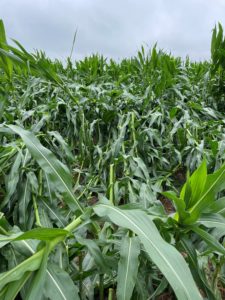
Tucker Miller, Drew, sent these photos of sun scald on corn leaves and a common issue in corn fields throughout the state this year, delayed emergence, resulting in an uneven stand. (Click on photo to enlarge)

Leave a comment

Consultant Commentary – Up-to-Date Information from Mississippi’s Crop Professionals

Reporting from the South Delta is Virgil King, Lexington
We are off to a slow start this year with all the weather issues. We have corn up at this time but were not successful with getting all of it planted that was intended. Looks like to me we might have gotten about 60-70 % of intended acres planted. We have not been finding any insect or disease issues in the corn that is up. We have had a lot of issues with stands, frost and slow growing due to lack of good temperatures. A lot of our corn took way too long to come up. Growers have been doing what they can when they can get in the field but we have had very little field work this month. We have had a few soybeans planted but they are not up yet. No other crops have been planted at this time.

Reporting from South Mississippi is Trey Bullock, Hattiesburg
Corn is V-3 to V-5. Herbicides and side dress applications are being applied on a few fields. Corn looks fair right now. Cold, wet weather has it a little off color. Still have a grower with 1200 acre intentions and he is going to plant if we miss the rain Wednesday.
Last Saturday morning we had a frost over most of my area. I will be looking at wheat tomorrow (Wednesday) to see how the frost affected it. Most of the early varieties were at flowering. Later maturing varieties are just starting to head a little.
Checked soil temps yesterday around 9:00 and @ 4 inches it was 53. We will monitor soil temps this week and plant peanuts as temps get close to sufficient. Cotton will be planted next week if conditions allow.
These are some photos of sun scald on corn. (click on photo to enlarge)

Reporting from the North Delta is Ed Whatley, Clarksdale
Cotton – had one cotton grower start planting today
Corn- Had to replant 1/3 to 1/2 of early planted corn. Started back planting today, will stay with corn until it rains again. After that, will start shifting more acres to soybeans and cotton.
Soybeans – very few beans planted
Weeds- started finding pig weeds 7-10 days ago

Reporting from the South Delta is Bruce Pittman, Coila
No cotton has been planted by any of my customers – they are still trying to “fix” this corn crop. About 60% of the corn planted has a less than desirable stand. We’ll keep acres with a plant population of 25,000 or better and replant acres with less. Some growers are using Select to kill the poor stands to replant and some are re-hipping and will replant. Oldest corn planted March 6 – 8th with no signs of stinkbugs. Frost nipped corn last Saturday (April 20th) but will recover. Applying fertilizer and herbicides when weather permits. It has rained every Wednesday or Thursday for the last month. Seeing lots of hog damage.
Only a few soybeans have been planted and no cotton. Cotton acres might increase slightly (from corn acres not planted) but my customers acres will be down 50 – 60% from 2012 overall.

4/24/13 – Reporting from the North Delta is Justin George, Merigold
Rice- 2/3 planted in Bolivar Co. Behind overall. It’s taken 4 attempts for some very efficient planters to get that 2/3 planted. We should be thru. More acres would’ve gone in were it not for corn complications.

Corn- March 8-16 corn looks good and is needing herbicide to lay it by. Flying out some fertilize on some to get us by. March 20-21 corn really needs replanting, but will live with some thin stands due to not being able to replant or will plant beans and destroy corn. With so much yield depending on corn stands and “health at emergence” this crop will likely not match last year’s yield. People still planning to keep planting, but I hate to see May 1st planted corn be 3-5 leaf and NEED water around 20 days after emergence. We won’t like that scenario.
Soybeans- a few acres planted last week that are emerging now. Overall everyone is behind. Probably not 5% planted. Will be facing a lot of bug pressure.
Overall the biggest and best thing this year was last fall’s (and this early spring’s) burndown. Those that thought they would burndown near planting, or still need to work ground are facing a big problem.

Leave a comment

Consultant Commentary – Up-to-Date Information from Mississippi’s Crop Professionals

Reporting from the South Delta is Will Price, Oakland
Corn – Maybe 10% planted at most. Biggest concern at this point is uniformity of stand emergence. Hopefully with lack of DD50’s to this point, it won’t be a serious issue.
Soybeans- I have seen a few planters going but very few.
Wheat – Cool weather and excess moisture cause me concern for the expectation of this year’s wheat crop. Most wheat in my area is from early boot to 50% heading. Striped rust had been an issue on limited acres and we are taking a “spray as needed” approach.

Reporting from the North Delta is Lee Boyd, Merigold
Beans – Just started planting beans, applying burndown and pre-emerge in front of planters or behind planters. A lot of pigweeds have come up and growing strong.
Wheat – Wheat looks good on well-drained soil and poor looking wheat on heavy flat type soils. Rust has really been bad on certain varieties, having to spray these fields twice with fungicide. Insect numbers are still low in wheat.
Rice – First planted rice (around March 21st) still doesn’t have a complete stand. Rice planting has started this week in full swing, a lot of burndown and pre-emerge herbicide going out.
Corn – One of the worst starts I have ever seen. First planted corn looks good with low insect numbers. Middle age corn has lower populations but enough to keep unless the birds keep hurting stands. Last planted corn will be a lot of replanted corn especially if it was planted on heavy type soils even if it had a good row. Bolivar County is really taking a hard hit on having to replant corn. Some replants will go to soybeans.

Reporting from the South Delta is Jason Grafton, Madison
Intended corn acres is south delta area may be 50% planted. Growth stages up to V4 with uneven stands and damage from hogs the biggest issues. Farmers may start switching gears on planting intentions soon.
Wheat from 10% up to 80% headed.
No beans or cotton in the ground from my customers.
Received an inch of rain last night in Madison area.

Reporting from South Mississippi is Trey Bullock, Hattiesburg
Not a lot of change since last report. Not sure of total rainfall overnight but it sure didn’t help dry anything out. Forecast lows for tonight are 36-39 across my area. Wheat is very vulnerable to more freeze damage at this point, so 39 would be a lot better than 36. Planted corn has jumped this past week and is from V-3 toV-6. Growers tried to apply herbicides in a few fields this past Wednesday and Thursday but fields were still too wet.


Walked several fields yesterday (Thursday) that have a few small pigweeds emerging. These fields were along the Ms river and resistance is a big problem. Growers were hoping to plant these fields now but rain and cool weather will delay. 10 day forecast is showing several days in mid 40′s through next Thursday so cotton planting is not looking good. Hopefully forecast will change soon and growers can get in fields. Hope everyone has a great weekend.

Reporting from East Mississippi is Bert Falkner, West Point
Received 2 inches of rain last night !

Tucker Miller, Drew, sent this photo of freeze damage on wheat. Click on image to enlarge.

Leave a comment

Wild hogs and birds causing stand loss in Mississippi corn crop

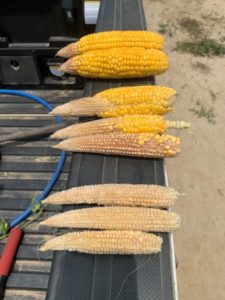
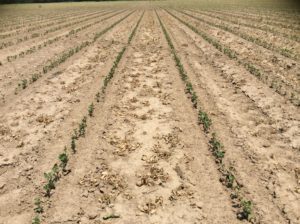
Tucker Miller, Drew, Miss., sent these photos of the destruction of corn stands in the Delta region of Mississippi. Click on the following photos for a larger view.

Leave a comment

Tebuconazole Label Restrictions in Wheat – Dr. Tom Allen, MSU Extension Plant Pathologist

Wheat Disease Update: March 30, 2013
Allen, T.
IMPORTANT NOTICE: Tebuconazole Label Restrictions in Wheat
By Tom Allen, Extension Plant Pathologist, on April 2nd, 2013

Over the past couple of weeks I have heard several people discuss their fungicide intentions for the remainder of the wheat season. During the past two weeks quite a few fields have been observed to have severe stripe rust “hot spots” in localized areas that in some cases have developed into much larger areas in short periods of time. But, with that said, all fields do not contain hot spots and this requires a good deal of scouting to verify the presence of the disease. A popular fungicide chemistry for use in wheat, especially to manage such diseases as stripe rust (based on efficacy as well as cost), have been products that contain the active ingredient tebuconazole as a stand-alone product. The specific products with a label for wheat include:
-Embrace*
-Folicur 3.6F
-Monsoon
-Muscle 3.6F
-Onset 3.6L
-Orius 3.6F
-Tebu 3.6F
-Tebucon 3.6F
-Tebu-Crop 3.6F
-TebuStar 3.6L
-Tegrol
-Tebuzol 3.6F
-Toledo 3.6F
NOTE: some of the above products may have a Federal label but NOT be labeled for application to wheat in Mississippi. Based on my search it appears that Embrace may not labeled for use in MS.
The labeled rate for application in wheat is 4 fl oz/A. However, keep in mind, that ALL of the fungicides listed above make one specific restriction that is clearly defined on the label:
“A maximum of 4 fI. oz. of a product may be applied per acre per crop season.“
Therefore, if you have applied a stand-alone tebuconazole fungicide this season you cannot come back at a later application timing (such as 10.5; heading complete and immediately prior to beginning flowering) and make an application with Prosaro. Even though information is lacking on the Prosaro label as to this specific restriction the terminology on the Prosaro (prothioconazole + tebuconazole) label also indicates that a maximum of 8.2 fl oz/A of Prosaro can be applied per acre per crop season. A full label rate, or 8.2 fl oz/A of Prosaro, contains 4 fl oz of tebuconazole.
Please keep this in mind prior to deciding on a fungicide application product. I suspect that much of the decision regarding the use of Prosaro as a fungicide late in the season is simply due to one of the latest application timings available on the label in addition to being a good product for preventing Fusarium head blight (Feekes 10.5.1; beginning flowering). Several other fungicides have a label for Fusarium head blight, as well as a late, Feekes 10.5, application timing pre-harvest interval should you need to make an application of a fungicide targeted at Fusarium head blight

Leave a comment

W. N. (Bill) Batson Inducted into the MACA Hall of Fame

MACA HALL OF FAME INDUCTEE WILLIAM N. (BILL) BATSON
February 5, 2013


In 2001, the MACA Board of Directors saw a need to recognize and honor those members who excelled in their agricultural expertise, integrity, and service to this organization. Consequently, the MACA Hall of Fame was established. It remains as the highest, most prestigious award that any member can obtain.
To date, thirteen (13) members have been bestowed this honor. Inductees or their families receive a personal plaque. In addition, a standing plaque listing each inductee is displayed at this university.
Today, we have the honor and privilege to recognize a distinguished gentleman for his achievements and contributions to the field of entomology, the MACA and the State of Mississippi.
Bill Batson was born in Perkinston, MS and grew up on a dairy farm. His parents were Walline & Clark Batson who were school teachers and the District Forest Ranger for south Mississippi. During WWII, his parents demonstrated their patriotism by traveling to Keesler Air Force Base at Biloxi daily to instruct incoming flight students the complex fuel systems of B17 bombers.
After graduation from high school in 1944, Mr. Batson joined the Navy and attained the grade of Signalman Petty Officer 3rd Class. He served on the USS Battleship Arkansas and was deployed in the Pacific for 2 years, participating in the invasion of Iwo Jima and Okinawa. He witnessed the raising of the flag on Mount Suribachi.
After the war, Mr. Batson enrolled in Perkinston Junior College on a football scholarship playing quarterback and running back. After graduating from Perkinston, he attended Mississippi State University receiving his undergraduate degree in Entomology with a minor in Horticulture and Chemistry. He also received a fellowship to teach freshman biology while completing his master’s degree.
In 1951, Mr. Batson moved to Greenville, MS to work for an implement company selling insecticides and scouting their client’s crops. Within two years, he began his own independent crop consulting business. Bill Batson retired in 1999 and at the time of his retirement, he still consulted for some of the same clients or their children that he attained at the start of his consulting career.
During his 50 years as an agricultural consultant, Bill Batson worked with several research projects involving 13 different insects; discovered and helped eradicate the pink bollworm in the Delta; was an early advocate for tarnished plant bug control; consulted on cotton, rice, wheat, corn, milo and soybeans and is a charter member of the Mississippi Entomological Association.
Mr. Batson retired in 1999 after, as he put it, “50 years of good health, God’s blessings, and good friends, and moved to Wiggins, MS to be closer to my beginnings.”
Bill Batson is married to Carolyn Chennault Batson and is the father of 6 children: Lynn, Leila, Lisa, (all who received degrees from MSU) Pepper, Bryan & Blair. He has 5 granddaughters and 2 grandsons.
In recognition of Bill Batson’s achievements, dedication, perseverance, and integrity to his profession and this association, we honorably induct William N. (Bill) Batson into the MACA Hall of Fame.

Induction Ceremony conducted by Bob Stonestreet, Clarksdale, Miss.

5 Comments

Virgil King, III, Named “2011 Cotton Consultant of the Year”

Congratulations to Virgil King, III of Lexington, current MACA President, on being named “2011 Cotton Consultant of the Year”. Virgil received the prestigious honor, which was presented by Cotton Farming magazine and Syngenta, at the recent Beltwide Cotton Conference in Orlando.

To see the article and photographs go to the following link at Cotton Farming magazine and click on “Winner Cotton Consultant of the Year” on the upper right hand corner of the home page.

http://www.cottonfarming.com

Leave a comment

John M. “Kim” Kimbrough, III inducted into MACA Hall of Fame

The late John M.  “Kim”  Kimbrough, III was inducted into the MACA Hall of Fame at the 38th Annual Conference held on January 27-28, 2011.  MACA member, Bob Stonestreet, presented Kim’s wife, Debbie, with a plaque and read the following tribute:

“In 2001, the MACA Board of Directors saw a need to recognize and honor those members who excelled in their agricultural expertise, integrity and service to this organization. Consequently, the MACA Hall of Fame was established. It remains as the highest, most prestigious award that any member can obtain. To date, ten (10) members have been bestowed this honor. Inductees or their families receive a personal plaque. In addition, a standing plaque listing each inductee is displayed at this university. (Mississippi State University)

Today, we have the honor and privilege to recognize a distinguished gentleman for his achievements and contributions to the field of entomology and the Mississippi Agricultural Consultants Association.

John M. “Kim” Kimbrough, III was a life-long resident of Lexington, Miss. and a 1969 graduate of Mississippi State University. While at MSU, he was a member of the Block and Bridle Club and Alpha Zeta Honorary Agriculture Fraternity, having been awarded scholarships from both organizations.

Kim was a charter member and a past president of the Mississippi Agricultural Consultants Association (MACA). He remained active in this organization, serving as a Director and on various committees until his untimely death in March of 2009. It wasn’t unusual for newly elected officers to seek his advice or call on him for an opening or closing prayer, including this speaker. His reputation of honesty and integrity will be sorely missed.

Kim was also a past president of the National Alliance of Independent Crop Consultants (MAICC) 1982-1983, was the recipient of the 1982 Leadership Award by Ag Consultant and Fieldman Magazine, the 1990 recipient of the National endowment for Soil and Water Conservation Award, the 1994 American Cyanamid Consultant of the Year and the 1999 MAICC Service to Agriculture Award. He was a past director of the Holmes County Livestock Association and the Mississippi Cattlemen’s Association; past president of Holmes County Farm Bureau; past president of the Lexington Rotary Club and was serving as Chairman of the Holmes County Soil and Water Conservation Board at the time of his death.

Kim was Elder and Clerk of the Session, First Presbyterian Church, Lexington, Miss. He was a private pilot, a Hunter Education Instructor and on the Troop 64 Advisory Council.

He was a devoted husband, father, son and friend to all who met him. Kim is survived by wife Deborah “Debbie” Magee Kimbrough; daughters Marianna Kimbrough Chapman and Olivia Kimbrough Logan; sons Robert Thomas Kimbrough and John M. Kimbrough, IV and seven grandchildren.

Because of Mr. Kimbrough’s dedication, perseverance and integrity to his profession and this association, we honorably induct John M. Kimbrough, III into the MACA Hall of Fame, the most prestigious award this organization has to offer.”

Leave a comment
  • Subscribe


  • 41th MACA Annual Conference

    February 4 - 5, 2014 Bost Ext. Center, MSU
  • Archives